What Is Domiciliary Care? A Complete Guide for West Sussex Families

If you’ve come across the term “domiciliary care” while researching support for a loved one, you’re not alone in finding it a little unclear at first. It’s a formal, care-sector term that simply means care delivered in someone’s own home — but understanding exactly what it covers, how it works, and what to expect matters a great deal once you’re actually arranging it.
This guide answers the question “what is domiciliary care” in full, then looks specifically at how domiciliary care in West Sussex is arranged, what it costs, and how to choose a provider you can trust.
What Is Domiciliary Care?
Domiciliary care is professional care and support delivered to someone in their own home, rather than in a residential care home or nursing facility. The word “domiciliary” simply refers to the home — so domiciliary care is, at its core, home-based care.
It’s a broad term covering everything from a short daily visit to help with washing and dressing, through to full-time, live-in support for those with more complex needs. What defines domiciliary care isn’t the level of support provided, but the setting — the person remains in their own home throughout.
This is an important distinction for families weighing up their options. Domiciliary care isn’t a single fixed service; it’s a flexible framework that can be adjusted as needs change, without requiring a move into residential care.

Domiciliary Care vs Home Care: Is There a Difference?

In practice, “domiciliary care” and “home care” are used interchangeably by most providers and families. Domiciliary care is the more formal, regulatory term — it’s the language used by the Care Quality Commission (CQC) and in official care sector documentation. “Home care” is the more everyday term families tend to search for and use in conversation.
If you see a provider describe themselves as a “domiciliary care agency,” this simply means they’re a CQC-registered organisation providing care in people’s homes — exactly the same thing most people mean when they talk about home care.
What Does Domiciliary Care Include?
Domiciliary care can cover a wide range of support, typically including:
- Personal care — washing, dressing, and support with daily hygiene routines
- Medication support — prompting, reminders, and monitoring
- Companionship — social interaction and emotional support, particularly for those living alone
- Household tasks — meal preparation, light housekeeping, and shopping
- Mobility support — help moving safely around the home
- Live-in care — continuous, round-the-clock support for higher-dependency needs
- Respite care — short-term cover to give family carers a break
Most domiciliary care packages combine several of these elements, built around what the individual actually needs rather than a fixed, one-size-fits-all package.
Who Is Domiciliary Care For?
Domiciliary care supports a wide range of people, not just older adults. It’s commonly arranged for:
- Elderly individuals who need support to remain safely independent at home
- People living with dementia who benefit from familiar surroundings and routine
- Adults with physical or learning disabilities requiring ongoing support
- People recovering from surgery, illness, or a hospital stay
- Family carers who need respite, short-term cover
- Anyone with a long-term health condition requiring regular support
The common thread is a preference — or a clinical recommendation — to remain at home rather than move into a residential setting.
Domiciliary Care West Sussex: How It Works Locally
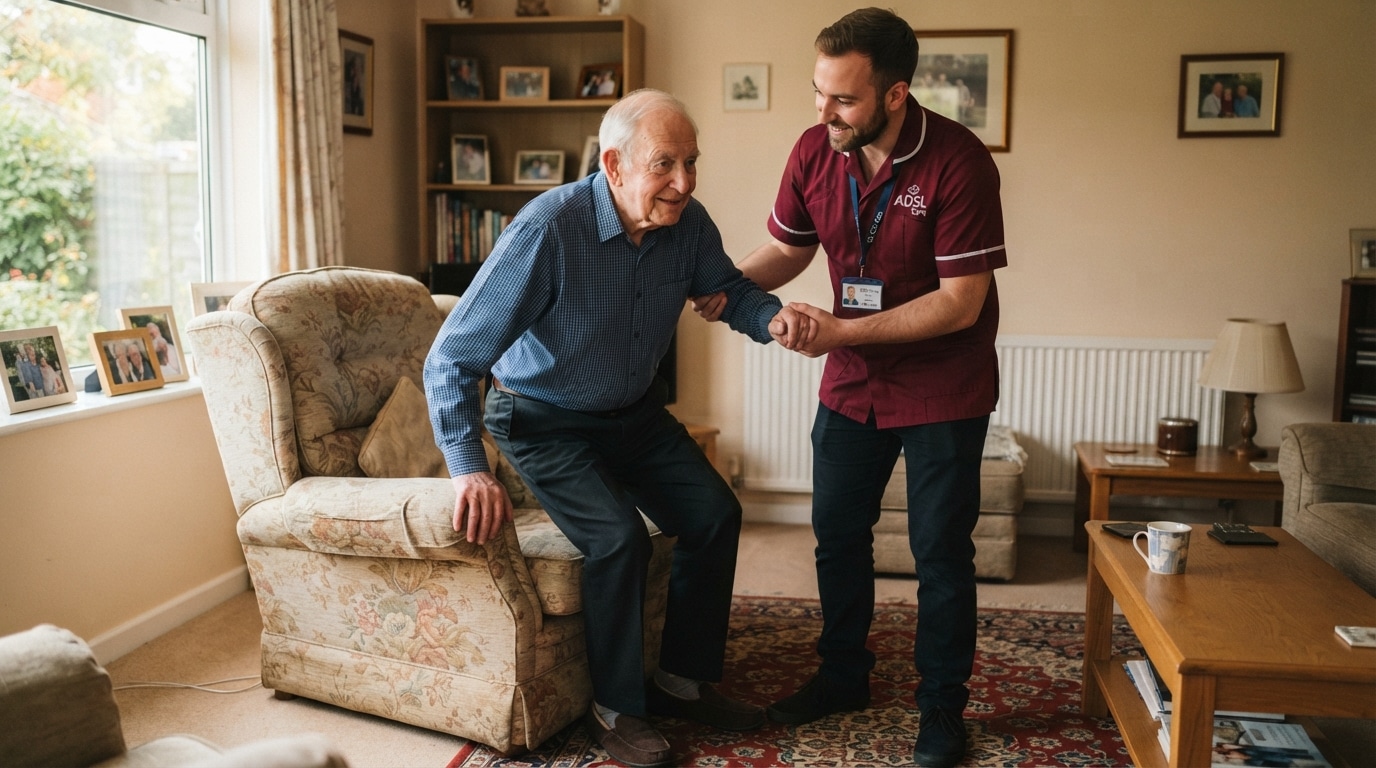
Across West Sussex, domiciliary care is delivered by CQC-registered agencies providing visiting and live-in support to families throughout the county — from rural areas like West Chiltington, Pulborough, and Storrington, through to larger towns including Horsham, Crawley, and Chichester.
The process typically follows the same structure wherever you’re based in West Sussex:
- Initial enquiry — a call or online form, often triggered by a specific concern or change in circumstances
- Free home assessment — a coordinator visits to understand needs, routines, and the home environment
- Personalised care plan — services, schedule, and pricing are agreed based on the assessment
- Care begins — private domiciliary care can often start within days
- Ongoing review — the plan is revisited and adjusted as needs evolve
Because domiciliary care in West Sussex is delivered by a mix of national chains and smaller local agencies, it’s worth understanding what sets providers apart before choosing one — covered in more detail further down.
Private Domiciliary Care vs Council-Arranged Care
Domiciliary care in West Sussex can be arranged in two main ways:
Council-funded domiciliary care is arranged through West Sussex County Council, following a formal needs assessment and financial means test. Support is allocated based on assessed need and available budget, and the process — from assessment through to care actually starting — can take several weeks.
Private domiciliary care is arranged directly with a provider, without a means test or local authority waiting list. It offers more control over which agency you choose, faster start times, and greater flexibility to adjust the level of support over time.
Some families choose to combine the two — using a council-funded package as a base and adding privately funded visits where additional support is needed.
How Much Does Domiciliary Care Cost in West Sussex?
Costs for domiciliary care vary depending on the type and frequency of support required:
- Visiting care is typically charged per visit or per hour, with rates varying by time of day, weekends, and visit duration
- Live-in domiciliary care is charged as a daily or weekly rate rather than per visit
- Respite care is usually priced similarly to live-in care, for the period required
A trustworthy domiciliary care provider will always carry out a free, in-home assessment before offering a quote, since accurate pricing depends on understanding actual needs rather than working from a generic price list. Be cautious of any agency offering a fixed quote over the phone without first visiting.

Is Domiciliary Care Regulated?
Yes. All domiciliary care providers in England, including those operating across West Sussex, must be registered with the Care Quality Commission (CQC). Registration is a legal requirement for any organisation delivering personal care, and the CQC carries out regular inspections, publishing ratings from Inadequate through to Outstanding.
Before choosing a domiciliary care provider, it’s worth checking their current CQC rating directly on the CQC’s provider directory, and reading the full inspection report rather than relying on the headline rating alone. The report will cover specifics such as staff training standards, safeguarding practices, and how care plans are managed.
What to Look for in a Domiciliary Care Provider
Whether you’re arranging domiciliary care in West Sussex for the first time or switching providers, look for:
- CQC registration with a Good or Outstanding rating
- DBS-checked, fully trained caregivers
- Consistent staffing — the same small team visiting regularly, rather than rotating unfamiliar faces
- A named local coordinator, not just a call centre
- Transparent, itemised pricing with no hidden charges
- A genuinely personalised care plan, reviewed regularly rather than fixed at the outset
Caregiver consistency is worth asking about specifically. For clients with dementia or memory difficulties in particular, seeing familiar faces regularly makes a significant difference to comfort and trust — something worth confirming directly with any provider you’re considering.
Signs a Loved One Might Need Domiciliary Care
It’s not always an obvious, single moment that signals the need for domiciliary care. More often, it’s a gradual build-up of smaller changes:
- Increasing difficulty with washing, dressing, or personal hygiene
- A home that’s noticeably less tidy or well-stocked than usual
- Missed medication doses, or confusion around timing
- Reduced social contact or a loved one seeming withdrawn
- Family members quietly taking on more responsibility without it being formally acknowledged
- Minor accidents or near-misses around the home
If several of these sound familiar, arranging a free assessment is a low-pressure way to understand what support might realistically look like — without any obligation to proceed.
Domiciliary Care and Family Involvement
One aspect families sometimes overlook is how domiciliary care actually supports the wider family, not just the individual receiving it. Regular visits from a familiar caregiver can significantly ease the pressure on family members who’ve been managing informally — often for longer than they’d initially planned. Respite domiciliary care, in particular, gives family carers a genuine break without the guilt or logistical difficulty of arranging alternative cover themselves.
It’s worth having an open conversation as a family before care begins, covering how involved everyone wants to remain, how communication with the care agency will work, and how the arrangement might need to change over time. A good domiciliary care provider will welcome this involvement rather than treating family members as bystanders to the process.
Live-In vs Visiting Domiciliary Care
Once you’ve decided domiciliary care is the right direction, one of the next decisions is whether visiting care or live-in care better suits your loved one’s needs.
Visiting domiciliary care involves scheduled calls throughout the day — anywhere from a single short visit to four or more — with a caregiver arriving at set times to help with specific tasks such as morning personal care, medication, or an evening check-in. It suits clients who are largely independent but need support with particular routines at particular times of day.
Live-in domiciliary care means a caregiver stays in the home continuously, providing round-the-clock support and companionship. This tends to suit clients with more complex needs, those at higher risk of falls — particularly overnight — or anyone who feels anxious being alone. It also allows many people to avoid moving into residential care altogether, since full-time support is delivered without leaving home.
Neither option is universally better than the other. The right choice depends on the individual’s specific needs, daily routine, and how much support is realistically required at different times of day. A good domiciliary care provider will talk through both options honestly during the initial assessment, rather than defaulting to whichever is more profitable for them to deliver.
How Domiciliary Care Plans Are Reviewed Over Time
A common misconception is that a domiciliary care plan, once agreed, stays fixed. In practice, needs rarely stay static — and a good provider builds regular review into the arrangement from the outset.
Reviews typically happen at set intervals (often every few months) but should also be triggered by any noticeable change: a fall, a change in mobility, a new diagnosis, or simply a family member noticing something isn’t quite working as well as it did. Ask any prospective provider directly how often reviews happen, who’s involved, and how quickly the care plan can be adjusted if something changes between scheduled reviews. A provider that treats the care plan as a living document — rather than paperwork completed once and filed away — is generally a strong sign of quality.
Frequently Asked Questions
What is domiciliary care in simple terms? Domiciliary care is professional care delivered to someone in their own home, covering anything from short daily visits to full-time live-in support.
Is domiciliary care the same as home care? Yes, the terms are used interchangeably. “Domiciliary care” is the more formal, regulatory term, while “home care” is the everyday term most families use.
Do I need a council assessment to arrange domiciliary care? No. Private domiciliary care can be arranged directly with a provider, without going through a council needs assessment or means test.
How quickly can domiciliary care start in West Sussex? Many private providers, including ADSL Care, can begin domiciliary care within days of an initial assessment.
Is domiciliary care suitable for dementia care? Yes, many domiciliary care providers offer specialist dementia care, with caregivers trained in structured routines and consistent staffing to reduce confusion and distress.
Can domiciliary care be combined with council-funded support? Yes, some families use a council-funded package as a base and add privately funded domiciliary care visits for additional support.
Domiciliary Care West Sussex with ADSL Care
ADSL Care is a CQC-registered domiciliary care provider based in West Chiltington, delivering domiciliary care across Horsham, Crawley, Shoreham, Chichester, Worthing, and the wider West Sussex area. Every caregiver is DBS-checked and fully trained, and every care plan is built around the individual — from personal care and companionship through to live-in and respite support.
Every arrangement begins with a free, no-obligation assessment in your loved one’s own home, giving you a clear, pressure-free picture of what domiciliary care could look like for your family. To explore the full range of support available, see our guide to home care services in West Sussex, or read more about choosing the right home care provider.
To find out more, call us on 01798 667012 or complete our online enquiry form.
Related posts


Write a Comment
Popular Posts


Testimonials
Recommended by a friend, very helpful and professional. The care is outstanding and the office team are very experienced and assisted me with sourcing additional funds for my mums care. Thank you ADSL Care

vincent Harrison
ADSL have fantastic carers and are a wonderful team! They have put me and my family at ease and my Mum looks forward to her daily visits. Would recommend to anyone looking for carers.

Sandra Booth
We recently changed our care agency to ADSL Care, we are very pleased with the care we receive for my mother. Care staff are caring and professional. Office staff and management are very approachable and accommodating.

Caroline Knight
We used ADSL care to help support my wife, the carers were all very lovely and caring. The office staff were very kind and answered all of our questions.

Brian Pownall