Dementia Care at Home in West Sussex: How to Support a Loved One and Adapt Your Home

When dementia enters a family, it changes every room in the house.
Not just in the practical sense — though the practical changes are real and significant. It changes the atmosphere. The rhythm of daily life. The way family members speak to each other, look at each other, and worry about each other in the small hours.
For families in West Sussex who are managing a loved one’s dementia at home, this guide is written to help. It covers the practical steps that make home safer and more navigable for someone with dementia, the role of professional dementia care in supporting the person and the family, and the honest signals that suggest it is time to increase support.
It is written not to alarm, but to equip. Because knowledge, in this situation, genuinely helps.
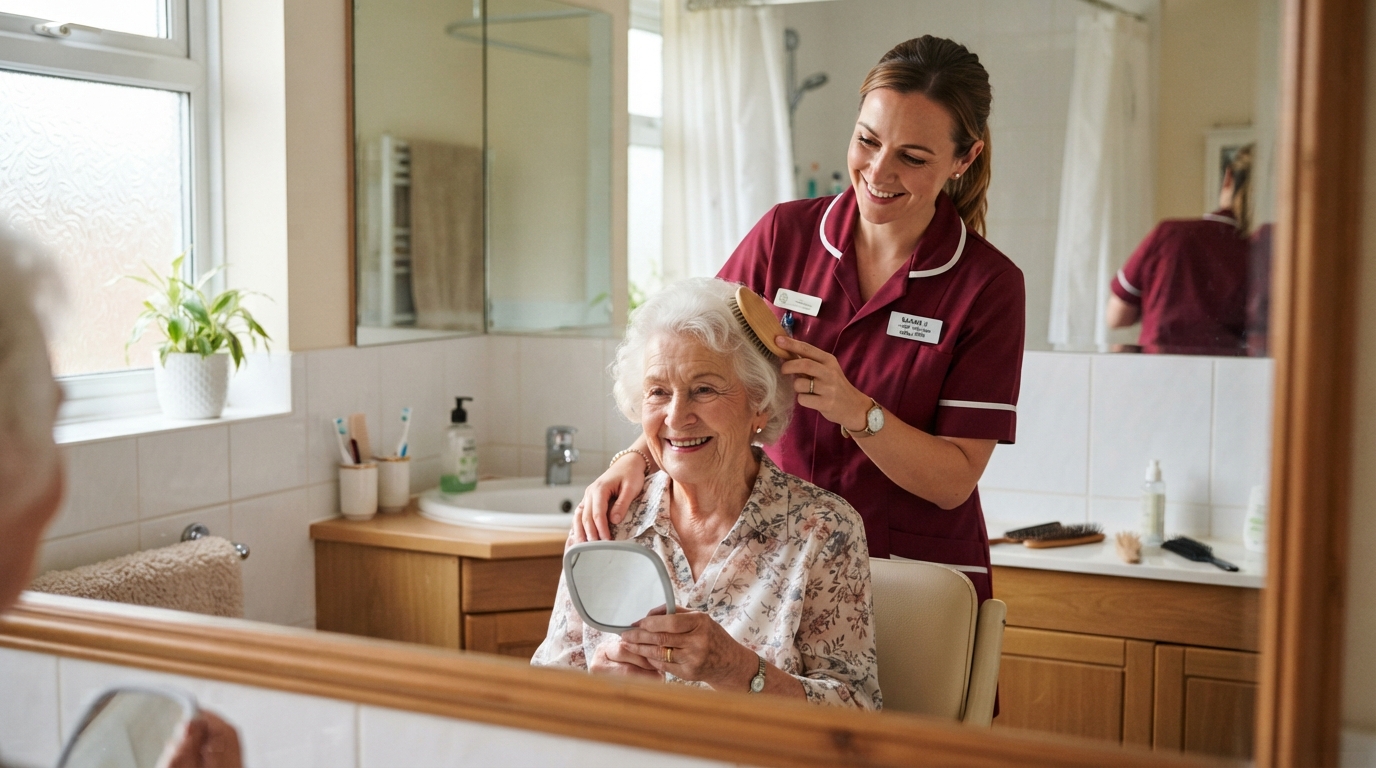
Why Home Is So Often the Best Place for Someone with Dementia
This might seem like a strange place to start — with an argument for something rather than practical advice. But it matters, because many families carry an implicit assumption that dementia inevitably leads to a care home. And that assumption can prevent them from investing in home-based support that would have worked, and would have been better.
The evidence supporting home care for people with dementia is substantial. Familiar environments reduce disorientation — the spatial memory that helps someone navigate their own kitchen is more durable than many other cognitive capacities, and it only functions in a familiar space. Established routines provide a framework that reduces anxiety. Known faces — carers who visit consistently, family members, neighbours — provide an anchor of recognition even as other memories fade.
When someone with dementia is moved to a residential setting — even a good one — disorientation typically increases. New corridors, new rooms, unfamiliar faces, different smells, different sounds. The cognitive effort required to navigate a new environment can precipitate a decline that was not inevitable.
This does not mean that residential care is never the right answer. There are stages and circumstances where it is. But the presumption should be in favour of home, with sufficient support, for as long as that is genuinely safe.
Making the Home Safer: Practical Adaptations
The home of someone with dementia does not need to be transformed into a clinical environment. But some targeted adaptations can significantly reduce risk and improve daily functioning.
In the Kitchen
The kitchen contains the most concentrated set of hazards in any home. An automatic gas/electric cut-off device on the hob is one of the most valuable investments for a household where someone with dementia lives alone. Removing or securing cleaning products and chemicals is important — visual similarity to food or drink can lead to dangerous confusion.
Consider whether independent cooking is still appropriate. If it is not, removing temptation (locking the hob, or arranging for meals to be provided by a carer) is safer than relying on judgment that may no longer be reliable.
In the Bathroom
Install a shower seat and grab rails if not already in place. Place non-slip mats in the bath and shower. Ensure hot water temperature is set below 43°C at the boiler to prevent scalding. Add labels on taps if hot/cold distinction is causing confusion. Fit a door handle on the outside of the bathroom door if there is any risk of the person becoming locked inside.
Throughout the Home
Ensure good lighting — particularly on stairs and in hallways, and motion-sensitive night lights between bedroom and bathroom. Remove loose rugs and trailing cables. Consider whether stair gates are appropriate if falling on stairs is a risk. Label rooms with simple signs or pictures if the person is becoming confused about which room is which. Remove or cover mirrors if reflections are causing distress or confusion (this is more common than people realise in mid-to-late stage dementia).
At the Front Door
Wandering is a significant safety concern for people with dementia — particularly at night. A door alarm that sounds if the front or back door is opened while the carer or family is not watching can prevent potentially dangerous situations. Some families also choose a key safe on the outside of the property so that carers, emergency services, or family can gain access without breaking down the door.
The Role of Routine in Dementia Care
If there is one principle that underpins effective dementia care at home, it is this: routine is everything.
The cognitive architecture of dementia tends to preserve procedural memory — the memory of sequences and habits — longer than episodic memory. A person who cannot remember what they had for breakfast may still be able to follow a morning routine they have performed for decades, if that routine is consistent and the steps are familiar.
This has a direct implication for care. A carer who visits at the same time, follows the same sequence, uses the same language, and does things in the same order gives a person with dementia the best possible chance of engaging cooperatively with their care. A different carer, at a different time, doing things differently, removes all of those anchors.
It is why consistency of carer — not as an optional extra, but as a fundamental requirement — matters so profoundly in specialist dementia care.
Communicating with Someone Living with Dementia
Communication changes as dementia progresses, and the way family members and carers interact needs to change with it. Some principles that make a genuine difference include:
- Approach from the front: Position yourself at eye level. Approaching from behind or above can startle and distress the person.
- Keep sentences clear and direct: Give one instruction at a time. Allow ample time for the person to process and respond.
- Never argue with their reality: If they believe it is 1985, correcting them causes distress without helping. Entering their reality gently and redirecting is far more effective.
- Use their name frequently: Name recognition is one of the most durable pieces of personal identity.
- Respond to the emotion behind the words: A statement like “I want to go home” from someone who is already at home is expressing anxiety or longing, not a geographic error. Address the feeling of safety.
- Prioritise non-verbal communication: Tone of voice, facial expression, and gentle touch communicate safety even when spoken words are not processing well.
Core Insight: Dementia care is not primarily about what you do. It is about how you do it. The quality of the interaction — the patience, warmth, and willingness to follow the person’s lead — determines the experience of care far more than any task or technique.
Managing Behavioural Symptoms at Home
Dementia frequently involves behavioural symptoms that can be frightening or exhausting for families: agitation, anxiety, aggression, repetitive behaviours, sleep disturbance, and in some cases paranoia or hallucinations.
Understanding these symptoms as expressions of unmet need — for reassurance, for comfort, for recognition, or for reduced stimulation — is far more practical than treating them as problems to be suppressed. Ask yourself: What is the person trying to communicate? What is making them feel unsafe?
Proven strategies to de-escalate distress include:
- Identify triggers: Agitation often follows patterns related to time of day (“sundowning”), specific activities, or background noise. Identifying the pattern makes prevention possible.
- Reduce stimulation: Turn off background noise like television or radio during challenging periods to prevent sensory overload.
- Use familiar music: Music from the person’s young adult years is one of the most effective interventions to reduce anxiety.
- Maintain physical comfort: Check for unaddressed physical discomforts like pain, hunger, thirst, or the need to use the toilet.
- Validate and redirect: Agreement and gentle redirection are almost always more effective than logical correction.
When to Increase Professional Support
The practical reality of managing dementia at home is that needs evolve over time. What is manageable at one stage may require extra support at the next. Indicators that it is time to scale up support include:
- Night-time wandering is becoming frequent or unsafe.
- The person is repeatedly putting themselves at risk during the day when alone.
- Personal care routines cause severe resistance, distress, or physical strain.
- Nutritional intake is suffering, resulting in weight loss or meal refusal.
- The primary family carer is experiencing extreme fatigue or health issues.
- A new medical complication requires specialized daily oversight.
None of these signals means that remaining at home is impossible. They simply mean that the level of care needs to adjust — whether by increasing visiting calls, adding overnight care, or transitioning to full-time live-in care.
Professional Dementia Support Across West Sussex
At ADSL Care, our specialist dementia care service is delivered across West Sussex — including Pulborough, Storrington, Billingshurst, Petworth, and Horsham — by carers who receive dedicated dementia training and are selected for their warmth, empathy, and patience.
If your family is managing dementia care at home and would like to discuss what additional support or respite care might look like, we are here to help. No obligation — just an honest, supportive conversation.
📞 01798 667012 | 🌐 adslcare.co.uk
Related posts


Popular Posts


Testimonials
Recommended by a friend, very helpful and professional. The care is outstanding and the office team are very experienced and assisted me with sourcing additional funds for my mums care. Thank you ADSL Care

vincent Harrison
ADSL have fantastic carers and are a wonderful team! They have put me and my family at ease and my Mum looks forward to her daily visits. Would recommend to anyone looking for carers.

Sandra Booth
We recently changed our care agency to ADSL Care, we are very pleased with the care we receive for my mother. Care staff are caring and professional. Office staff and management are very approachable and accommodating.

Caroline Knight
We used ADSL care to help support my wife, the carers were all very lovely and caring. The office staff were very kind and answered all of our questions.

Brian Pownall